Nothing Except Power - A Look at the Evolution of Dodge Challenger Models

Understand Dodge Challenger more through the years. From its legendary inception in 1970 to the modern models, explore the iconic design, powerful performance, and timeless appeal that have made it the symbol of American muscle car heritage
In American automotive culture, muscle cars hold a significant share, with many classic models enduring to this day. And the Dodge Challenger is one of them. The three major American automotive manufacturers, Ford, General Motors, and Chrysler, have each produced their own unique muscle cars, namely the Mustang, Camaro, and Challenger, which are widely known and celebrated. Our spotlight today is on the Dodge Challenger, the youngest and perhaps the most tragically destined among them.
The first generation (1970 - 1974)
In the 1960s, Ford and Chevrolet introduced their muscle cars, the Mustang and Camaro, respectively. Dodge couldn't see this large piece of the pie being divided between them, so they launched the first-generation Challenger. The initial Challenger had a distinct and powerful design, with sharp angles that captivated many consumers. Its iconic "four-eyed" round headlights became one of its trademarks. In terms of power, the base model featured a 3.7L inline-six engine, while the higher-end models were equipped with a 6.3L V8 engine, delivering an impressive 335 horsepower. Just a year after its release, consumers witnessed the Challenger's formidable power. However, it seemed they were not satisfied and desired a Challenger model that could rival the Shelby GT500 in terms of power. Dodge didn't back down and packed a 7.0L HEMI engine into the Challenger R/T, reaching a staggering 425 horsepower. In that era, this figure was considered astronomical. Although this car didn't achieve the same track performance as the Shelby GT500, it seems that the American people preferred the thrill of burning rubber during acceleration.
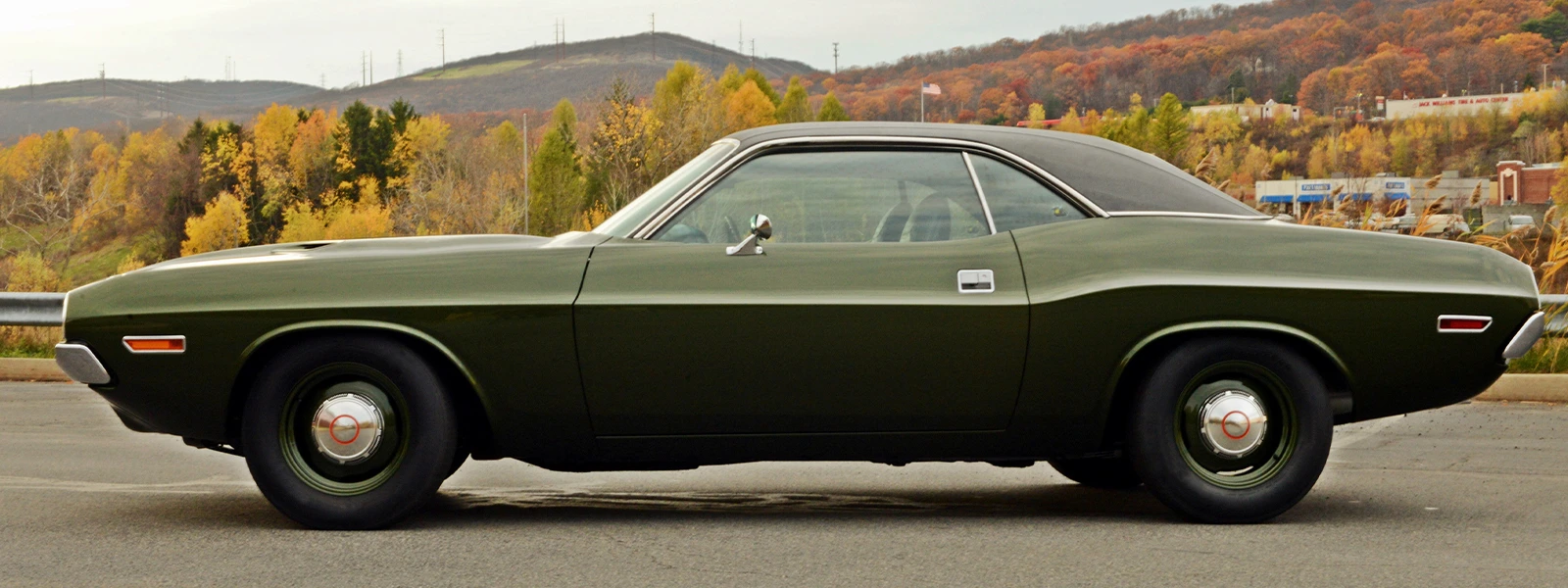
The first-generation Challenger can be considered the epitome of a classic muscle car, playing the role of a tough guy in many American settings. Its most famous portrayal is in the "Fast and Furious" series, where the protagonist, Dominic Toretto, almost always drives various versions of the first-generation Challenger, leaving a lasting impression on people. If you spot a first-generation Challenger on the streets abroad, your immediate association would likely be with a vehicle owner who embodies the image of a muscular man wearing a sleeveless tight-fitting T-shirt.
The second generation (1976 - 1983)
With the outbreak of the oil crisis, in 1974, the final unit of the first-generation Challenger rolled off the assembly line, marking the end of production for that model. As the oil crisis subsided, in 1976, Dodge made the decision to revive the Challenger project. However, at that time, Dodge was burdened with significant debt and lacked the resources to develop an entirely new platform. Therefore, Dodge had to seek platform sharing with other manufacturers to keep the Challenger alive. Eventually, Mitsubishi came into the picture, and after discussions, Dodge decided to adopt the platform of Mitsubishi's Galant Lambda sports car (known as the Mitsubishi Galant Λ).
Thus, an "unconventional" sports car was born. While it maintained the rugged styling cues of the Challenger, it was essentially a rebadged Mitsubishi Galant Lambda. In terms of power, it only offered two options: a 1.6L and a 2.6L inline-four engine. Even the 2.6L engine (with the engine code 4G54, the same as the Mitsubishi Pajero V32) produced just over 100 horsepower at best. Such power figures didn't resonate with the American people who favored high-horsepower muscle cars. This generation of the Challenger lost its advantage in terms of power and also lacked the refined elegance of the Mitsubishi Galant Lambda, making it the most unsuccessful iteration of the Challenger. It became known as a "grocery-getter" on the streets. In fact, on some foreign used car websites, the second-generation model is not recognized as a Challenger and is instead categorized under the Mitsubishi Galant Lambda series. After seven years of production, the second-generation Challenger exited the stage of history amidst widespread criticism.
The third generation (2008 - 2023)
After being out of sight for 25 years, Dodge felt that the once-revered Challenger should not be forgotten. Additionally, with the immense popularity of the film "Fast and Furious", the demand for used first-generation Challengers surged, driving up their prices. It became clear that the plan to resurrect the Challenger had to be put on the agenda immediately. Dodge opted to utilize the rear-wheel-drive platform of the Chrysler 300C to create the third-generation Challenger. Unlike the Camaro and Mustang, the Challenger did not excessively alter its style to conform to contemporary aesthetics. Instead, it embraced the design language of the original model. This approach proved to be the right one, as the classic and retro Challenger garnered significant popularity within the United States. It captivated consumers who appreciated its timeless appeal.
In 2008, a time when turbo technology was advancing rapidly, Dodge, in order to deliver a satisfying experience to its loyal fans, chose to stick with the classic naturally aspirated engines. The base model featured a 3.6L V6 engine, delivering a maximum horsepower of 285Ps. The R/T model came equipped with a 5.7L V8 HEMI engine, producing a maximum horsepower of 352Ps. The SRT8 model boasted a 6.1L V8 engine, delivering an impressive maximum horsepower of 425Ps. Following the mid-cycle refresh in 2011, the base model was upgraded to a brand-new 3.6L Pentastar engine, producing a maximum horsepower of 305Ps. The 5.7L engine option continued to be available, and the SRT8 model received a new 6.4L HEMI engine, cranking out a maximum horsepower of 476Ps.
In response to the increasing demand for power, Dodge also recognized this trend and subsequently introduced the renowned Hellcat models. The Hellcat variant took the 6.4L HEMI engine, enhanced it, and added a supercharging system, resulting in a staggering maximum horsepower of 727Ps. It featured a distinctive dual-key design, with the black key unlocking 500Ps of horsepower and the red key unleashing the full power. If that's still not enough for you, don't worry, Dodge went even more extreme with the ferocious Hellcat Redeye, boasting a jaw-dropping maximum horsepower of 808Ps that commands respect.
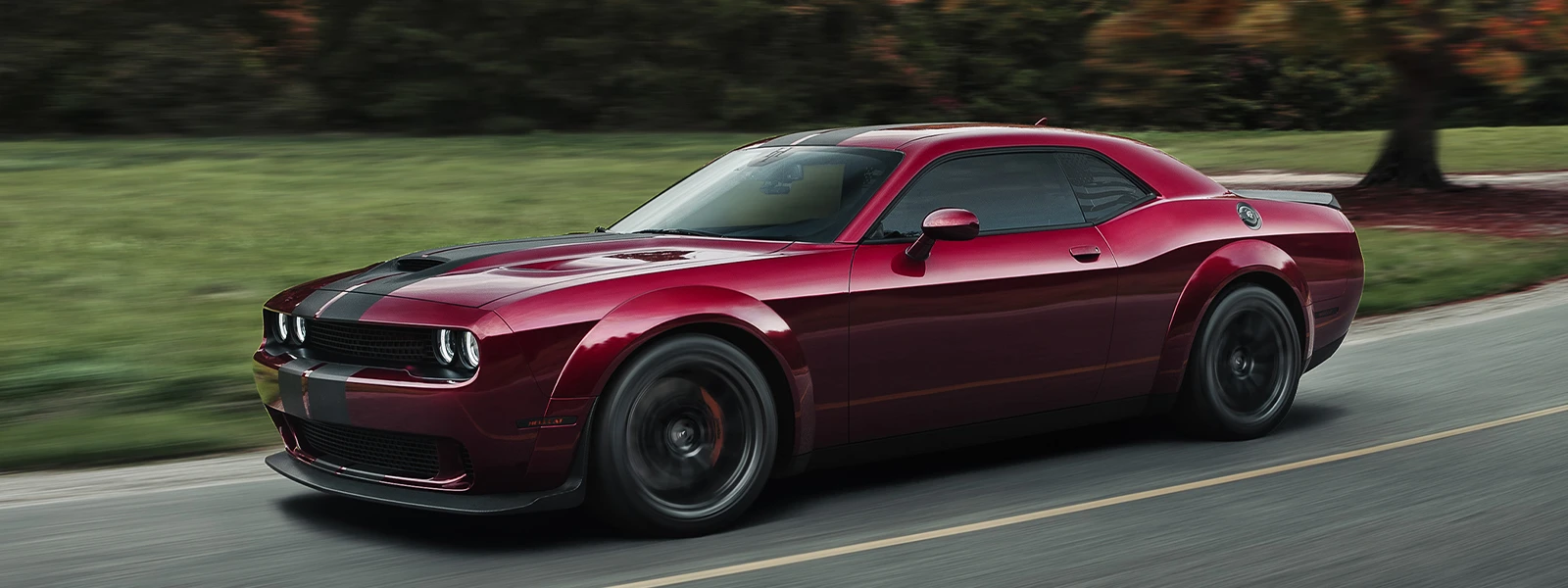
In 2018, as a gesture of gratitude for the significant contributions of the lead actors in the "Fast and Furious" film series to the Challenger lineup, Dodge unveiled the Challenger Demon. It was equipped with the same 6.2L supercharged engine as the Hellcat, but with even more aggressive tuning, resulting in an astonishing maximum horsepower of 840Ps. The Demon was offered as a limited edition model. Additionally, for just an extra $1 at the time of purchase, customers could opt to have the rear seats removed for further weight reduction. The Demon also came with a "Demon Crate" from the factory, which included specialized rear tires and wheels for drag racing, as well as an enlarged intake system. Its 0-100km/h acceleration time was an impressive 2.3 seconds. Such terrifying power output surpassed that of most supercars on the market. However, the excessive horsepower became a burden for the Demon, as its track performance was not exceptional. As a result, straight-line acceleration races became its stronghold. In factory stock condition, the Demon could complete a quarter-mile straight-line race in just 9.7 seconds. Considering this, the name "Demon" was truly fitting.
Since 2008, up until its official discontinuation in 2023, Dodge has not updated the Challenger model, despite the Camaro and Mustang undergoing generational changes and recent mid-cycle refreshes. However, Dodge firmly believes that "classic" and "retro" are the Challenger's biggest selling points. Even in the era of turbocharging, Dodge has continued to maintain the naturally aspirated power of the six-cylinder engine, which remains a favorite among car enthusiasts.
While the production of the internal combustion engine version of the Dodge Challenger has been discontinued, the legacy of this iconic car will never fade. If you are a proud owner of a Dodge Challenger, you are undoubtedly one of those who preserve the essence of classic. Take care of your cherished Challenger with A-Premium aftermarket Dodge parts. Our extensive selection includes components for the engine, brakes, drivetrain, suspension & steering, as well as a variety of interior and exterior accessories. Shop and make your selection!


