


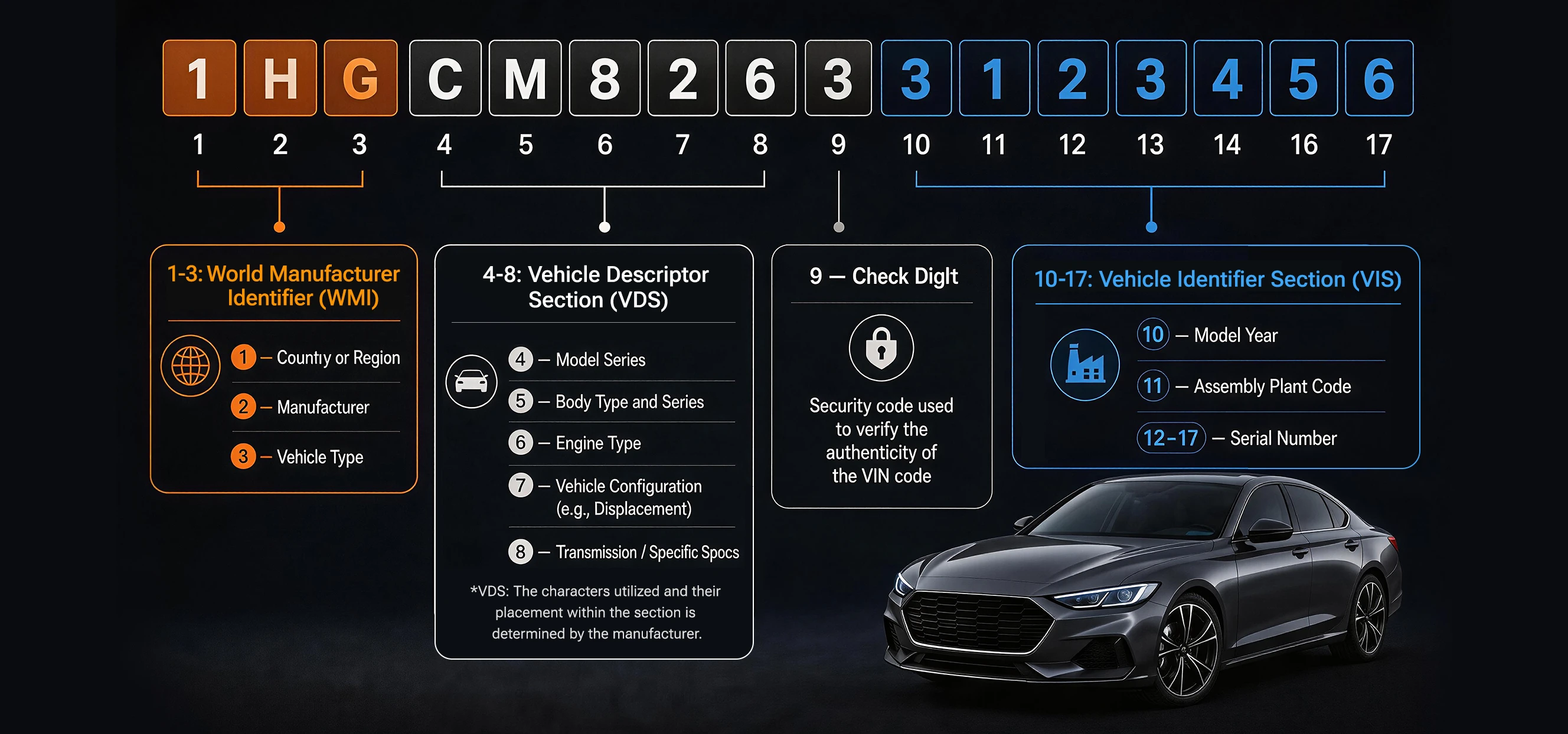
It accounts for specific production variations and trim levels. Two cars of the same year and model might have different brake systems or sensors; the VIN identifies exactly which ones were installed at the factory.
24/7 Customer service
Guaranteed Fit
Quickly find parts built to match your vehicle.
Why Use Our Free VIN Decoder?
Our professional VIN decoder can identify and decipher VIN information, transforming the standardized 17-character format into readable vehicle specs and details like year, make, model, and engine size from official databases such as NHTSA.
- Fast & Accurate: Uncover details about your car's year, make, model, trim, and engine in seconds.
- Universal Coverage: Our tool works for all major brands, including Ford, Toyota, Honda, Chevrolet, BMW, Mercedes-Benz, and Jeep.
- 100% Free: No sign-up required. Access reliable data on any device, anywhere.
- Trusted Source: We rely on VinAudit and NHTSA reporting to provide precise build data, helping thousands of technicians avoid compatibility errors.
What is a VIN Number?
A Vehicle Identification Number (VIN) is a unique 17-character code that serves as your vehicle's unique fingerprint or "DNA". This identifier is essential for accurately sourcing auto parts, as it distinguishes your specific vehicle from all others.
Note: Per federal regulations, each vehicle manufactured in one stage must have a VIN assigned by the manufacturer. For vehicles built in multiple stages, the incomplete vehicle manufacturer assigns the code. Vehicle alterers must utilize the original VIN assigned by the manufacturer.
Where to Find the VIN?
Before you can use the free VIN lookup, you need to locate the 17-character string. It is typically printed in several locations on your vehicle and within your legal paperwork:
Dashboard (Most Common) :
Look through the windshield at the lower driver's corner; the VIN is often on a metal plate or sticker.
Driver's Side Door :
Open the driver's door and check the side of the door frame or the B-pillar label for a printed VIN.
Engine Block :
The VIN may be stamped on the engine block or other major assemblies; your owner's manual can point to the exact spot.
Dashboard (Most Common):
Refer to your vehicle registration, title, or insurance ID card for the VIN.
Label:
Check for stickers under the hood or near the radiator support.
Pro tip: When entering your VIN, be careful with similar-looking characters.Note: VINs never use the letters I, O, or Q to avoid confusion with the numbers 1 and 0.
What Does a VIN Mean?
A VIN is more than just a serial number; it is a complex code regulated by federal standards. By using a VIN decoder, you can decipher each character to identify key details about any motor vehicle—including the vehicle's plant of manufacture, model year, engine type, body style, and more.
Decoding Each Digit:
- Digits 1-3: - Indicates the country, manufacturer, and vehicle type
- Digits 4-8: - Details the model series, body type, engine type, vehicle configuration (such as displacement), and transmission or specific specs.
- Digit 9: Check Digit - A security code that verifies the VIN is authentic.
- Digit 10: Model Year - Identifies the specific year of production.
- Digit 11: Assembly Plant - Shows where your vehicle was built.
- Digits 12-17: Sequential Number - The unique serial number for your specific chassis.
Benefits of Finding Car Parts by VIN
Searching for parts using a VIN number lookup is the gold standard for DIY repairs and professional maintenance.
- Guaranteed fit: It distinguishes between different trims and mid-year production changes that generic “Year/Make/Model” searches might miss.
- Fewer Returns: Using a VIN lookup eliminates guesswork and prevents the frustration of ordering the wrong component.
- Exact Build Specs: VIN decoding distinguishes between different trims and chassis variations that share the same model name but require different parts.
- Precision for Luxury Imports: For brands like BMW or Mercedes-Benz, VIN decoding is often the only reliable way to navigate complex, highly specific parts catalogs.
Frequently Asked Questions
Why does VIN-based matching reduce wrong-part orders?
What should I do if my VIN lookup returns no results?
Can two vehicles have the same VIN?
Is it legal to perform a VIN check?
What if my VIN is not 17 characters long?
Can I use this for any car brand?
1-3 of 6