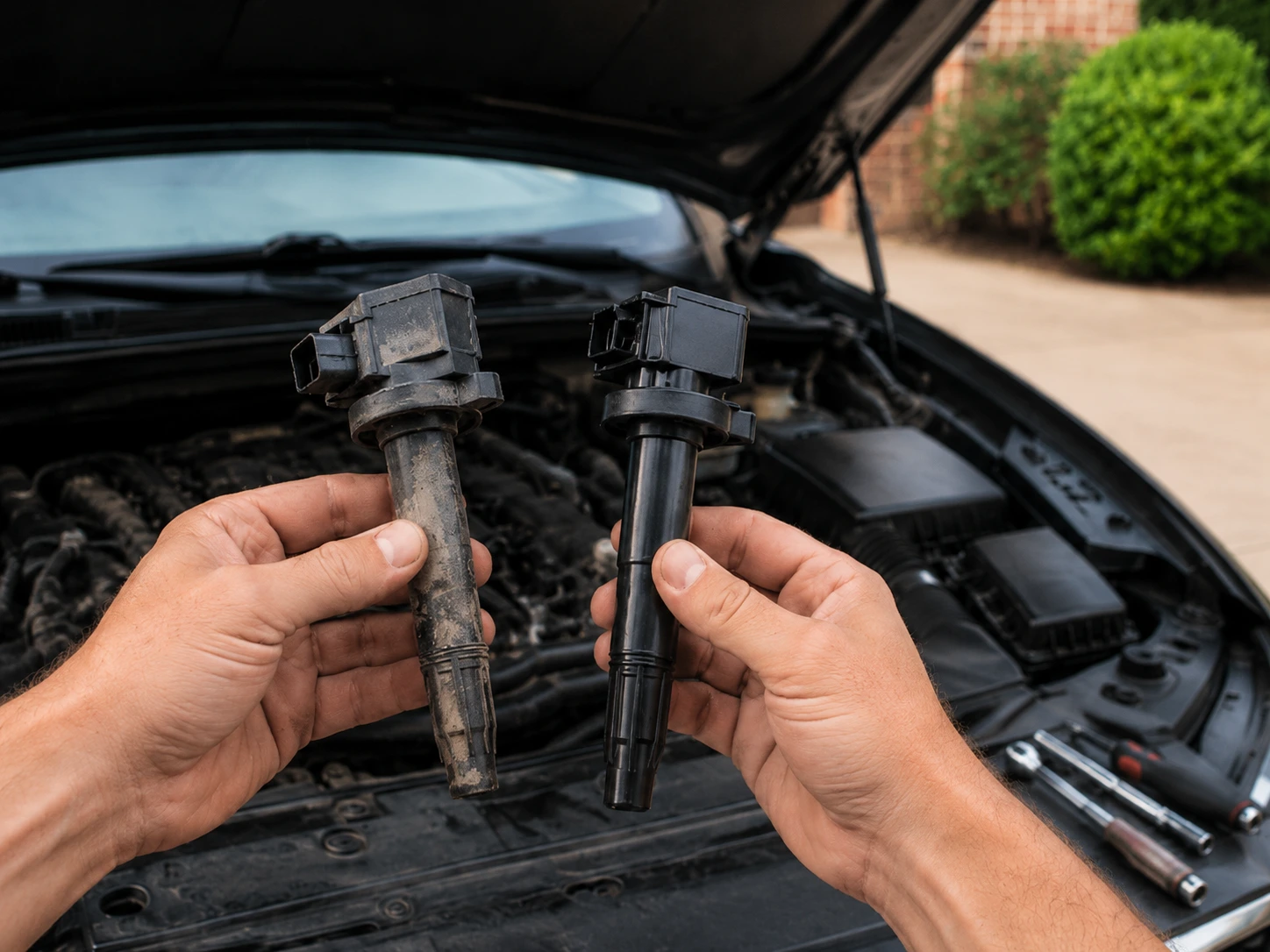
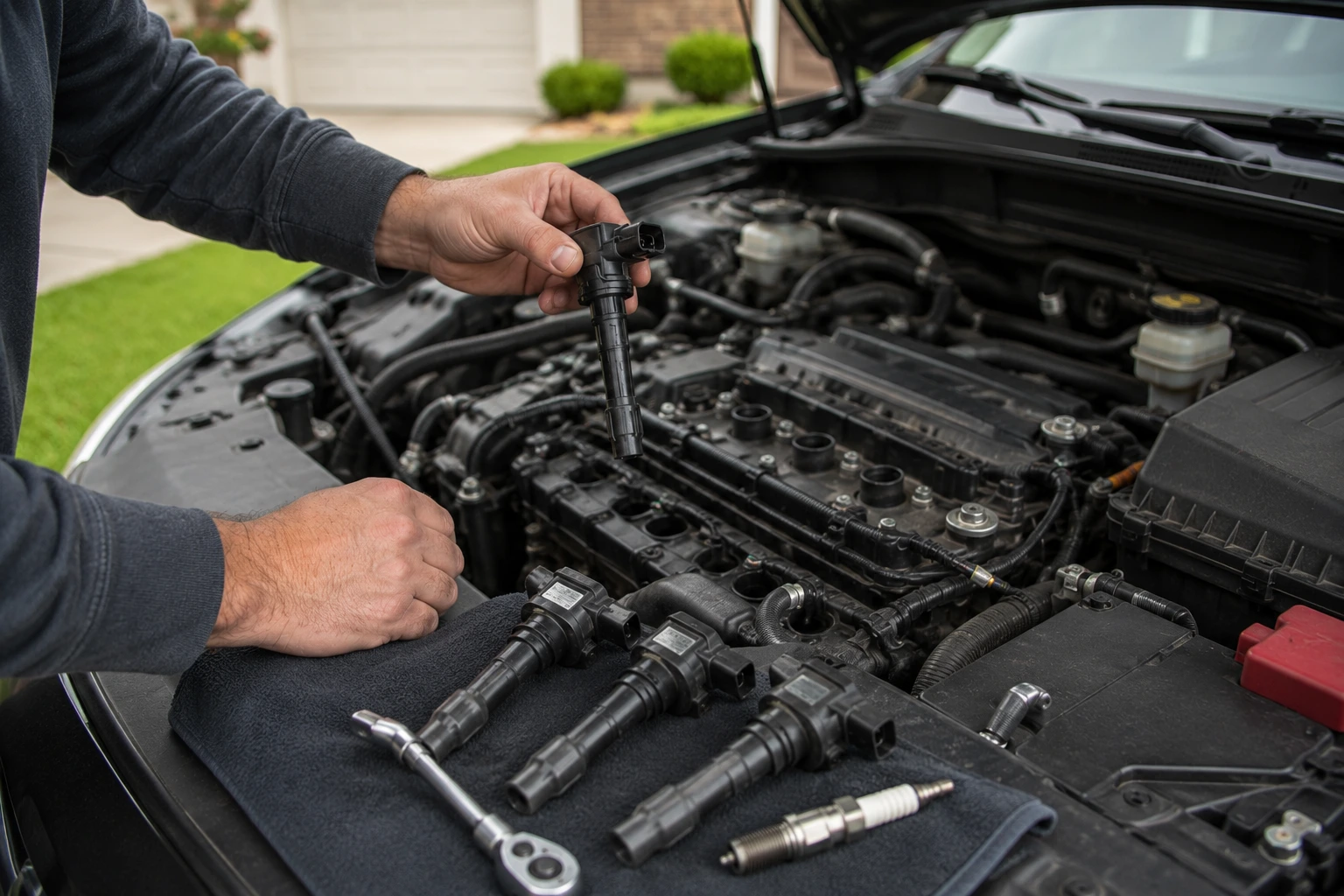
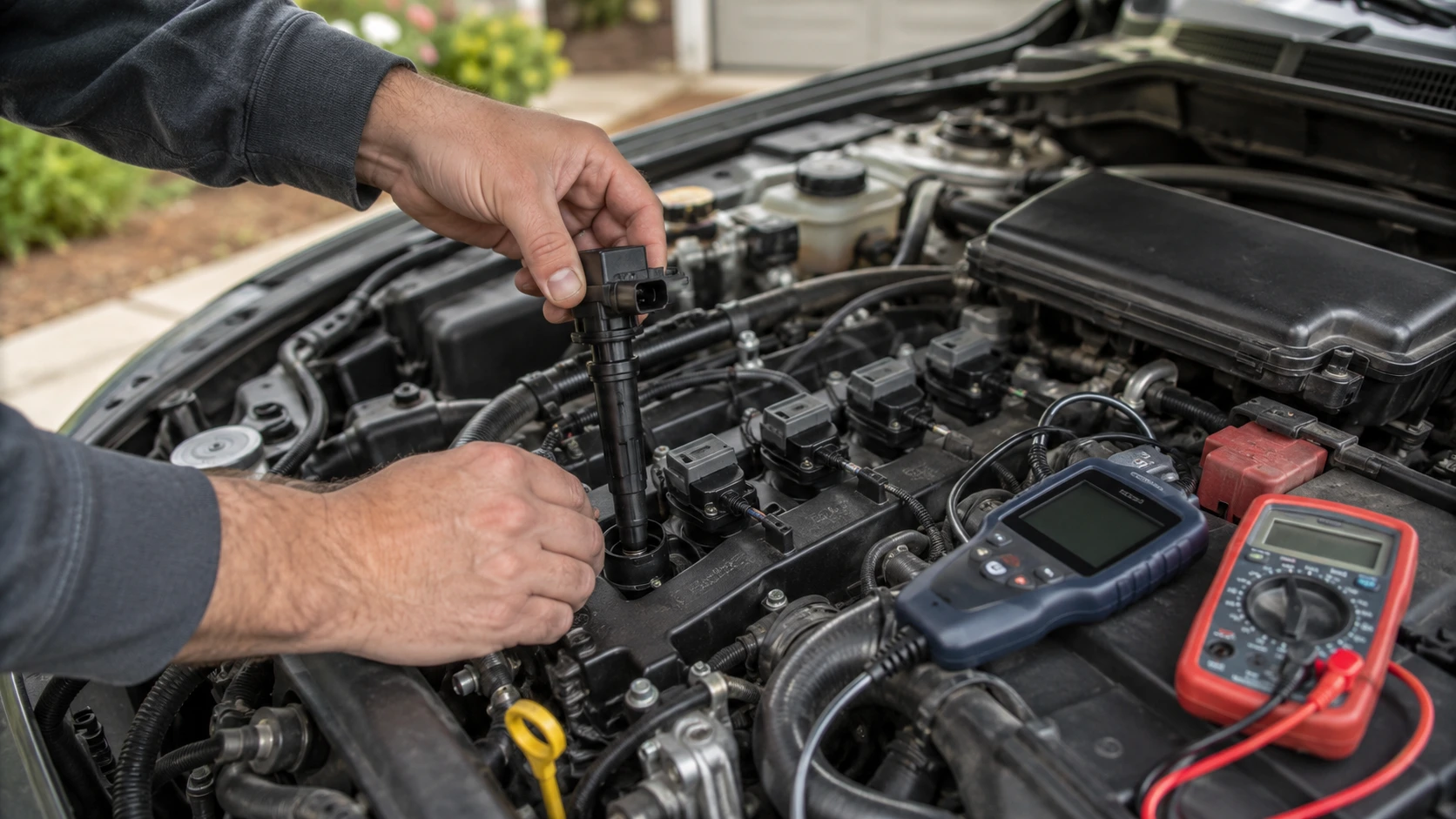
P0300–P0308: Misfire Codes
P0300–P0308 codes tell you where a misfire is happening. They do not always tell you why it is happening. The cause may be related to the ignition coil, spark plug, fuel delivery, air leaks, compression, or another engine system.
| Code |
Meaning |
Possible Ignition Coil Connection |
| P0300 |
Random or multiple cylinder misfire |
Multiple weak coils, worn plugs, fuel issue, vacuum leak, or compression issue |
| P0301 |
Cylinder 1 misfire |
Coil or spark plug on cylinder 1 |
| P0302 |
Cylinder 2 misfire |
Coil or spark plug on cylinder 2 |
| P0303 |
Cylinder 3 misfire |
Coil or spark plug on cylinder 3 |
| P0304 |
Cylinder 4 misfire |
Coil or spark plug on cylinder 4 |
| P0305 |
Cylinder 5 misfire |
Coil or spark plug on cylinder 5 |
| P0306 |
Cylinder 6 misfire |
Coil or spark plug on cylinder 6 |
| P0307 |
Cylinder 7 misfire |
Coil or spark plug on cylinder 7 |
| P0308 |
Cylinder 8 misfire |
Coil or spark plug on cylinder 8 |
P0351–P0358: Ignition Coil Circuit Codes
P0351–P0358 codes usually point more directly to an ignition coil primary or secondary circuit problem. That means the issue may be the coil itself, but it may also be the connector, wiring, power supply, ground, or PCM control circuit.
| Code |
Meaning |
Common DIY Interpretation |
| P0351 |
Ignition Coil A Primary/Secondary Circuit |
Check cylinder 1 coil or coil circuit |
| P0352 |
Ignition Coil B Primary/Secondary Circuit |
Check cylinder 2 coil or coil circuit |
| P0353 |
Ignition Coil C Primary/Secondary Circuit |
Check cylinder 3 coil or coil circuit |
| P0354 |
Ignition Coil D Primary/Secondary Circuit |
Check cylinder 4 coil or coil circuit |
| P0355 |
Ignition Coil E Primary/Secondary Circuit |
Check cylinder 5 coil or coil circuit |
| P0356 |
Ignition Coil F Primary/Secondary Circuit |
Check cylinder 6 coil or coil circuit |
| P0357 |
Ignition Coil G Primary/Secondary Circuit |
Check cylinder 7 coil or coil circuit |
| P0358 |
Ignition Coil H Primary/Secondary Circuit |
Check cylinder 8 coil or coil circuit |
For example, P0351 is commonly defined as an ignition coil “A” primary or secondary circuit fault. It is not the same as a generic misfire code.
Difference Between P0301 and P0351
P0301 and P0351 may appear together, but they do not mean the same thing. P0301 tells you cylinder 1 is misfiring. P0351 points more specifically to ignition coil A or its circuit.
| Code |
What It Detects |
What It Suggests |
| P0301 |
Cylinder 1 is misfiring |
Spark, fuel, compression, air, or sensor issue |
| P0351 |
Ignition Coil A circuit fault |
Coil, connector, wiring, or PCM control circuit |
If you have P0301 only, test the ignition coil and spark plug instead of replacing the coil immediately. If you have P0351 plus P0301, inspect the ignition coil and coil circuit first.
Common Causes of Ignition Coil Codes
Ignition coil codes can be caused by a failed coil, but the surrounding parts and circuits matter too. Check the full ignition path before deciding what to replace.
- Failed ignition coil
- Loose coil connector
- Damaged wiring
- Corroded terminal
- Oil or water in the spark plug well
- Bad spark plug
- PCM or ECM coil driver issue
- Poor ground or power supply
- Wrong coil part number
- Aftermarket coil not matched to the vehicle
DIY Diagnostic Workflow
-
Record All Codes
Do not clear codes before recording them. Write down freeze-frame data if your scan tool shows it.
-
Identify the Cylinder
A P0301 code points to cylinder 1. A P0302 code points to cylinder 2. For P0351–P0358, match the coil letter to the manufacturer’s cylinder layout.
-
Inspect Visible Issues
Look for loose connectors, oil in the plug well, water intrusion, or a cracked coil boot.
-
Swap the Coil
Move the suspected coil to a different cylinder and see whether the misfire follows the coil.
-
Replace the Confirmed Failed Part
If the misfire follows the coil, replace the ignition coil. If the spark plug is worn, replace spark plugs at the same time.
Can I Keep Driving With P0300 or P0351?
You should avoid extended driving with an active misfire. Misfires can reduce power, increase fuel use, and may damage the catalytic converter if unburned fuel enters the exhaust. If the check engine light is flashing, stop driving and diagnose the issue immediately.
FAQs
Does P0351 mean I need a new ignition coil?
Not always. P0351 means the PCM detected a fault in ignition coil A or its circuit. The coil may be bad, but the connector, wiring, or control circuit should also be checked.
Does P0300 mean all ignition coils are bad?
No. P0300 means random or multiple misfires. It can be caused by ignition coils, spark plugs, vacuum leaks, fuel delivery, sensors, or compression problems.
Why did my misfire code come back after replacing the coil?
The new coil may not be the cause. Check the spark plug, connector, wiring, fuel injector, compression, and whether the correct coil was installed.
Can one bad coil cause multiple codes?
Yes. A bad coil may trigger both a cylinder misfire code and a coil circuit code. Severe misfires may also create secondary codes related to fuel trim or catalytic converter efficiency.
Should I clear codes after replacing an ignition coil?
Yes, after the repair is complete. Then drive the vehicle and rescan to confirm the code does not return.