How a Bad Wheel Bearing Runout Quickly Destroys Your Brand New Brake Rotor

In this guide, we will break down the exact science of how a loose wheel bearing destroys brand-new brakes, how to diagnose it with a dial indicator, and how to stop throwing money away on repetitive repairs.


You just spent a Saturday afternoon or hundreds of dollars at a repair shop installing shiny, brand-new brake rotors and premium pads. For the first few hundred miles, your stopping power feels smooth, firm, and silent. But then, the dreaded symptom returns—a frustrating, violent pulsation in the brake pedal every time you slow down from highway speeds.
Your first instinct might be to blame a defective brake rotor or assume the metal "warped" under intense heat. However, here is the hard automotive truth: your new rotors are likely completely innocent. The real killer is a silent assassin hiding right behind them—a failing wheel hub bearing.
When a wheel bearing develops even a microscopic amount of structural play, it triggers a destructive mechanical chain reaction known as hub runout. If left unaddressed, this hidden wobble will destroy a brand-new brake rotor in a matter of weeks. To prevent throwing money away on repetitive repairs, we must understand how these two systems rely on each other, how they fail, and how to accurately diagnose the root cause.

How the Wheel Bearing and Brake System Work Together
To understand why brakes fail prematurely, you first need to look at the structural architecture of the wheel end assembly. The braking system and the wheel hub assembly do not operate in isolation; they are mechanically married.
The Wheel Hub Bearing and Hub Assemblies: The Rotating Foundation
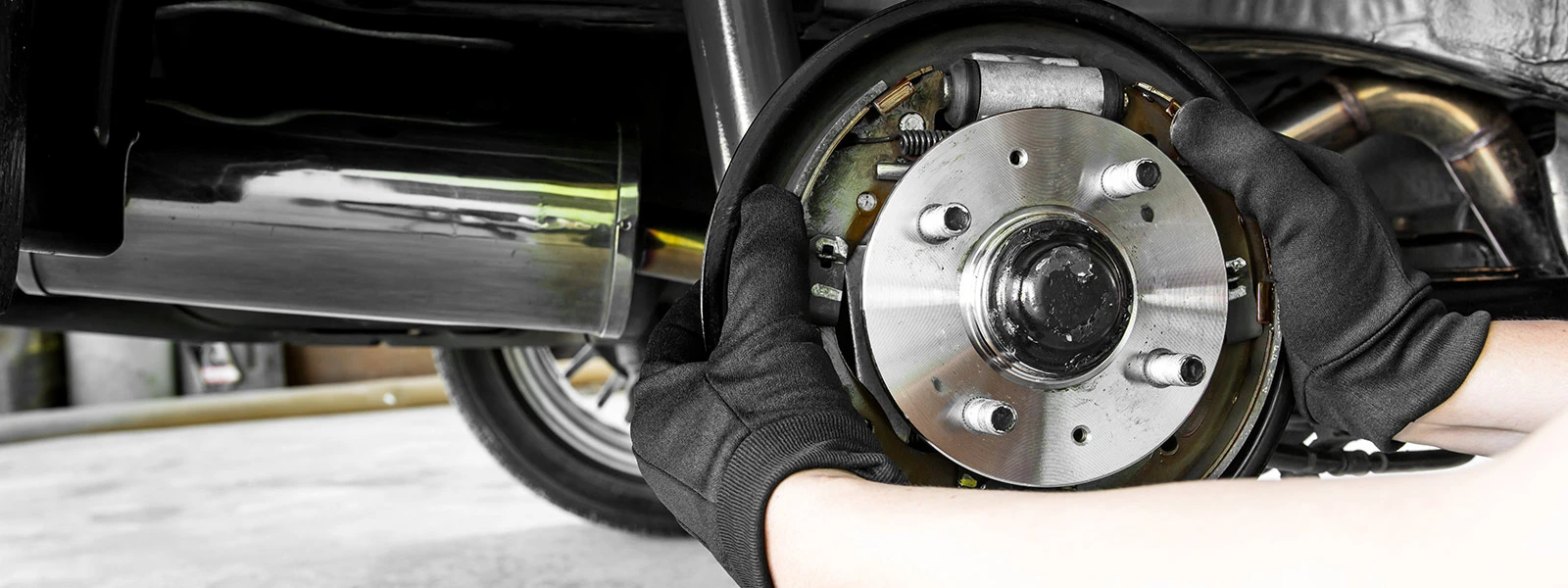
The wheel hub bearing assembly is bolted directly to the vehicle's steering knuckle or suspension spindle. Its primary job is to support the entire weight of the vehicle while allowing the wheels to spin with minimal friction. The outer face of this assembly features a flat, circular metal plate called the hub flange.
The Brake Rotor: The Stopping Component
The brake rotor (or brake disc) is the heavy metal component that your brake pads squeeze to slow the vehicle down. Crucially, the brake rotor does not bolt directly to the car's suspension. Instead, it features a center hat that slides directly over the wheel studs and sits flush against the machined face of the hub flange. When you bolt your wheel on, the lug nuts sandwich the brake rotor tightly between the wheel rim and the hub flange.
The Interdependent Mechanics
In a perfectly functioning system, the wheel bearing allows the hub flange—and consequently the brake rotor—to rotate in a flawless, perfectly perpendicular plane through the brake caliper.
Modern wheel hub assemblies have evolved through three distinct technological generations (Generation 1 split bearings, Generation 2 integrated flanges, and Generation 3 complete bolt-on units featuring integrated ABS sensors), with different generations used on driven and non-driven wheels and requiring proper installation to function correctly. Ball bearings are better suited for speed, while roller bearings handle higher loads more effectively. Quality aftermarket units are engineered with precision rolling elements, advanced sealing technology, and pre-loaded grease to improve performance and longevity. Regardless of the generation, the brake rotor relies entirely on the wheel hub to provide a perfectly flat, zero-tolerance foundation. If the foundation wobbles even a fraction of a millimeter, the entire braking architecture fails.

The Chain Reaction: Why and How the Damage Occurs
When a wheel bearing begins to wear out, the hardened steel balls or tapered rollers inside the bearing race lose their tight tolerances. This creates physical slack, structurally introducing a mechanical phenomenon known as Lateral Runout—a minute, side-to-side wobble as the wheel rotates.
Here is the exact step-by-step logical sequence of how that tiny wobble destroys a brand-new rotor:
Step 1: Runout Magnification
At the center of the wheel hub, a bearing play that causes a wobble of just 0.001 of an inch (0.025 mm) might seem negligible. However, because a brake rotor has a much larger diameter than the hub flange, that tiny variance is magnified exponentially by the time it reaches the outer braking edge of the rotor.
Step 2: Parasitic Cruising Friction
When your foot is completely off the brake pedal, your brake pads are engineered to ride a mere fraction of a millimeter away from the rotor surface. However, because the rotor is wobbling side-to-side due to the bad bearing, it physically slaps against the stationary inner and outer brake pads as it spins—even while you are just cruising down the highway with no braking pressure applied.
Step 3: Micro-Abrasion and Material Transfer
This constant, unintended scuffing creates localized hot spots on the rotor face. Over time, the intense frictional heat causes the friction formulation of the brake pad to unevenly deposit onto the low spots of the rotor. Concurrently, the mechanical abrasion grinds down the high spots of the rotor face.
Step 4: The Birth of Disc Thickness Variation (DTV)
Eventually, the rotor loses its parallel symmetry. One section of the rotor face becomes microscopically thinner or thicker than the rest. This is Disc Thickness Variation (DTV). Contrary to popular belief, brake rotors rarely physically "warp" or bend like a potato chip from heat; instead, they develop DTV because a wobbly wheel bearing forces them to wear unevenly against the pads.
Step 5: The Feedback Loop
When you finally step on the brakes, the caliper pistons are forced to violently pump in and out as they pass over these alternating thick and thin spots of the rotating rotor. This hydraulic disturbance travels up the brake lines, resulting in a pulsating brake pedal or a shaking steering wheel.

How to Tell If It’s a Hub Bearing or a Brake Rotor Fault
If your car is shaking or making noise, you must isolate the root cause before purchasing replacement parts. Use this logical diagnostic framework to determine who is to blame.
Scenario A: Is it a Brake Rotor Fault?
If the root cause is purely an isolated brake issue (such as cheap pad deposits or a sticking caliper), it will display these distinct characteristics:
-
Symptom Timing: The shaking, pulsation, or vibration happens exclusively when your foot is actively pressing down on the brake pedal.
-
Cruising Behavior: When driving at highway speeds without touching the brakes, the vehicle drives smoothly, and the steering wheel remains steady.
-
Visual Clues: A visual inspection of the rotor face might reveal dark, uneven heat spots or deep grooves.
Scenario B: Is it a Wheel Hub Bearing Fault?
If a failing wheel bearing is the true culprit causing the system failure, it will drop auxiliary diagnostic clues that brakes alone cannot produce:
-
Continuous Noise: A bad wheel bearing produces a low-frequency humming, rumbling, or growling noise (similar to an airplane or a loud off-road tire) that is present even when you are not braking. The noise typically intensifies as vehicle speed increases.
-
Tonal Shifts When Steering: The growling noise will change pitches or become significantly louder when you steer the car in one direction and quieter in the other, as the vehicle's weight shifts and loads or unloads the damaged bearing pack.
-
Dashboard Warning Lights: Modern hub designs feature integrated ABS tone rings or magnetic encoders. If bearing play causes the internal sensor wheel to move out of alignment with the wheel speed sensor, it will instantly trigger your ABS, Traction Control, or electronic stability dashboard warning lights.

The Ultimate Bench Test: The Dial Indicator (The Pro Method)
The only definitive way to catch a hidden hub defect before it ruins your new parts is by measuring lateral runout directly.
-
Remove the wheel, brake caliper, and brake rotor to expose the bare wheel hub flange.
-
Clean the hub face thoroughly with a wire brush to strip away all surface rust and debris.
-
Rigidly clamp a Dial Indicator Gauge base to a stationary suspension component, such as the steering knuckle.
-
Position the indicator tip perpendicular against the flat mating face of the hub flange.
-
Rotate the hub slowly by hand through a full 360-degree rotation and observe the total variance on the gauge.
-
The Decision Threshold: Most manufacturers specify that maximum allowable hub runout must be less than 0.002 inches (0.05 mm). If the gauge reads higher, the hub assembly itself is warped or worn and must be replaced before a new rotor is installed.
Cost Comparison Across Different Damage Scenarios
Ignoring a failing component alters the scope and cost of your repair. Below is an analytical breakdown of what you can expect to pay depending on how early you catch the problem.
Aftermarket replacements are widely available across many makes and models, including Toyota Camry, Honda Accord, and Ford F-150 applications.
Scenario 1: Early Detection — Isolated Brake Replacement
-
The Situation: Your wheel bearings are perfectly healthy, but your brake rotors have reached the end of their service life or suffered from an isolated sticking caliper.
-
Parts Needed: Brake rotors and a set of brake pads.
-
Estimated Cost: $150 to $400 (DIY) or $350 to $700 (Professional Shop, parts and labor).
Scenario 2: Early Detection — Isolated Wheel Hub Replacement
-
The Situation: You caught a humming wheel bearing early before its lateral runout had time to wear down or induce DTV on your existing brake rotors.
-
Parts Needed: One Wheel Hub and Bearing Assembly.
-
Estimated Cost: $100 to $250 (DIY parts cost) or $300 to $600 (Professional Shop per wheel, depending on vehicle make and model).
Scenario 3: Delayed Detection — The Combined Meltdown (Most Common)
-
The Situation: You ignored a humming wheel bearing or a slight brake pulsation for months. The wobbly hub bearing has completely worn down your brand-new brake rotors via DTV, or a seized brake caliper generated extreme friction heat that migrated into the hub, melting the internal bearing grease and destroying both systems simultaneously. This combined failure is especially high-risk for heavy-duty trucks like the Ford F-150, where massive towing loads accelerate both bearing play and rotor heat.
-
Parts Needed: Wheel Hub and Bearing Assembly, New Brake Rotors, and New Brake Pads.
-
Estimated Cost: $250 to $500 (DIY combined parts package) or $650 to $1,300+ (Professional Shop for full wheel-end overhaul).

Conclusion: Build Your Repairs on a Solid Foundation
A vehicle's braking system can only perform as straight as the hub it spins on. If your vehicle is plagued by chronic, recurring brake pulsation, uneven pad wear, or a mysterious grinding noise, stop replacing your rotors in isolation.
Taking the time to check for hub runout and investing in a high-quality, precision-machined aftermarket wheel hub bearing assembly alongside your brake overhaul ensures a perfectly flat mating surface. This simple, logical approach eliminates lateral runout at the root, protects your component investment, preserves your warranty, and ensures your stopping power remains smooth, quiet, and reliable.


