What is an AC Condenser?
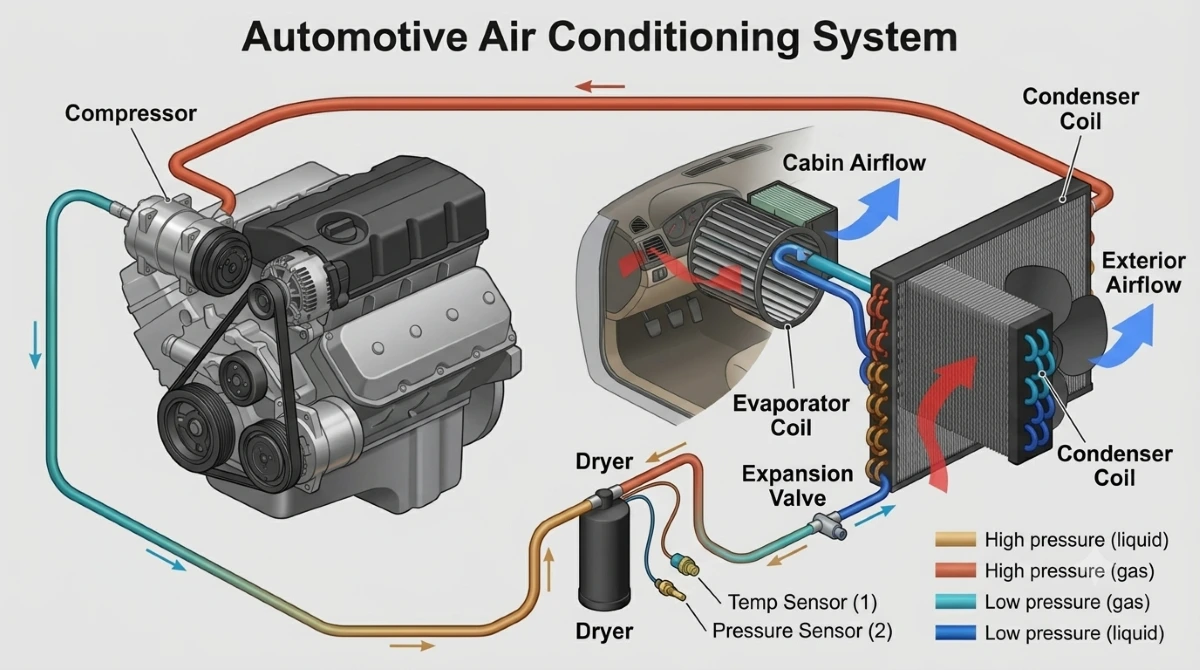
An AC Condenser (also commonly referred to as an A/C Condenser) is a critical heat exchanger situated at the very front of your vehicle's cooling stack, typically mounted right ahead of the radiator. Serving as the gateway for heat dissipation, its primary role within the A/C Air Conditioning loop is to shed the thermal energy absorbed from your vehicle’s cabin, ensuring that your climate control system can continuously deliver crisp, refreshing air.
How Does an A/C Condenser Work?
The thermodynamic process relies on pressure and phase changes to move heat out of your vehicle:
-
Compression: The A/C compressor pumps high-pressure, high-temperature gaseous refrigerant straight into the inlet of the AC Condenser.
-
Heat Exchange: As this boiling-hot gas flows through the inner tubes of the condenser, ambient air forced by the cooling fans and oncoming traffic passes over the ultra-thin aluminum cooling fins.
-
Condensation: This airflow extracts heat from the refrigerant, causing it to cool down and transition (condense) from a high-pressure gas into a high-pressure liquid.
-
Expansion: The liquid refrigerant then leaves the condenser and heads toward the expansion valve and evaporator coil to continue the cooling cycle.
Symptoms of a Failing A/C Condenser
Because it sits directly behind the grille, the condenser is highly vulnerable to both road debris impacts and internal wear. Watch out for these common warning signs that point to a failing unit:
-
Luke warm Cabin Air: If the fins are blocked, bent, or internally clogged, the system cannot shed heat efficiently, resulting in weak or warm airflow from your dashboard vents.
-
Visible Refrigerant Leaks: Physical damage from rocks can puncture the delicate tubes. Look for oily residue on the condenser fins, which indicates leaking refrigerant mixed with system oil.
-
Burning Odors or Overheating: When the condenser is failing to drop system pressures, the compressor works overtime, leading to overheating under the hood and a distinct burning smell.
-
Dashboard Error Codes: Modern HVAC control modules will often detect abnormal system pressures and trigger an A/C fault code or a check engine light.
DIY Repair & Maintenance Guide
Replacing a damaged A/C Condenser is an intermediate-to-advanced DIY project that can save you hundreds of dollars in shop labor costs.
⚠️ CRITICAL SAFETY NOTE: Federal law requires that automotive refrigerant be professionally recovered by a certified shop using specialized equipment before you open any A/C lines. Never vent refrigerant into the atmosphere.
Step-by-Step Replacement Sequence
1.Evacuate the System:Prerequisite。
Take your vehicle to a certified technician to safely evacuate and recover the R-134a or R-1234yf refrigerant from your A/C loop.
2.Clear Access to the Cooling Stack:15-30 mins。
Disconnect the negative battery terminal. Remove the front bumper cover, grille, and upper radiator brackets if necessary to gain clear access to the condenser assembly.
3.Disconnect Lines & Hardware:15 mins。
Unbolt the high-pressure refrigerant lines connecting to the condenser. Immediately cap the open lines with plugs to prevent moisture and dirt entry. Unclip any attached cooling fan shrouds or wiring harnesses.
4.Swap the Condenser:20 mins。
Unbolt the mounting brackets securing the old unit. Carefully lift the damaged condenser out. Before installing the new one, add the correct amount and type of PAG oil directly into the new condenser to replace what was lost. Slide the new unit into place.
5.Replace Seals & Reassemble:30 mins。
Always use brand-new, system-specific O-rings on the line fittings, lubricating them with a drop of clean A/C oil. Torque the line bolts to factory specifications to ensure a tight seal. Reinstall the bumper and body panels.
6.Vacuum & Recharge:Final Step。
Return to a professional shop to pull a deep vacuum on the system (to boil off any introduced ambient moisture) and recharge it with the precise weight of refrigerant required by your vehicle manufacturer.
What Else to Inspect & Replace Together
When opening your A/C Air Conditioning system for a condenser replacement, it is highly recommended to inspect and replace companion components to protect your investment:
-
Receiver-Dryer / Desiccant Element: This component acts as a moisture filter for the loop. Once the system is opened to atmospheric air, the desiccant quickly becomes saturated and must be replaced to prevent internal corrosion. (Note: Many premium condensers feature an integrated receiver-dryer).
-
A/C Compressor: If your original condenser failed due to internal contamination (such as metal shavings from a dying compressor), the compressor must be replaced and the entire system flushed to prevent immediate failure of your new parts.
-
Cooling Fans: Ensure the electric fans turn on and pull adequate CFM across the condenser face; weak airflow will quickly kill a new condenser's efficiency.
Why Choose an A-Premium AC Condenser?
When it comes to automotive climate control, precision engineering determines how long your system stays ice-cold. A-Premium offers a comprehensive catalog of OE-specification AC Condensers built to restore factory-level performance without the dealership price tag.
|
Feature
|
Cheap Alternatives
|
A-Premium Engineered Advantage
|
|
Material Quality
|
Low-grade recycled aluminum susceptible to early corrosion.
|
Premium 100% Virgin Aluminum construction for superior structural integrity and maximized heat transfer rate.
|
|
Fin Design
|
Stamped, loose-tolerance fins that bend easily and reduce airflow.
|
Micro-channel tube engineering with high-density multi-louvered fins designed to withstand rock impacts while optimizing thermal dissipation.
|
|
Fitment & Alignment
|
Universal or poorly measured brackets that require modification to fit.
|
Direct OE-fit validation utilizing strict drop-in geometry for effortless alignment with factory radiators and mounting tabs.
|
|
Quality Testing
|
Batch testing or visual inspection only.
|
100% helium leak-tested and pressure-validated at the factory floor to guarantee zero-defect out of the box performance.
|
Investing in an A-Premium A/C Condenser means getting a component that matches your original manufacturer's specifications precisely. Complete with a robust warranty and built for long-term durability, it's the smartest choice for DIYers and professional mechanics alike who demand reliable, ice-cold cabin temperatures through the hottest summer months.


